

'/%3E%3C/svg%3E)


Surgical masks are among the most frequently procured medical disposables worldwide. Yet not all surgical masks are equal — and the difference between a Type I and a Type IIR mask can be the difference between adequate protection and clinical-grade safety. For procurement officers, hospital buyers, and medical distributors sourcing surgical mask EN 14683 certified products internationally, understanding this standard is essential before placing any order.
This guide explains the EN 14683 standard, the differences between mask types, what to look for in a supplier’s documentation, and how Sier Sağlık meets every requirement.
What Is EN 14683?
EN 14683 is the European standard that defines the requirements and test methods for surgical masks intended to limit the transmission of infective agents from staff to patients during surgical procedures and other medical settings. First published by the European Committee for Standardization (CEN), the standard was most recently updated as EN 14683:2019+A1:2022.
The standard covers three performance types — Type I, Type II, and Type IIR — each defined by bacterial filtration efficiency and, in the case of Type IIR, splash resistance.
Type I vs Type II vs Type IIR: Key Differences
Type I masks have a bacterial filtration efficiency (BFE) of at least 95%. They are intended for patients and members of the public to reduce the risk of spreading infection. Type I masks are not intended for use by healthcare professionals in surgical or clinical settings.
Type II masks have a BFE of at least 98%. They are suitable for use by healthcare professionals in surgical and clinical environments where a high level of filtration is required.
Type IIR masks meet the same 98% BFE requirement as Type II, but additionally pass a splash resistance test (resistance to penetration by synthetic blood at 120 mmHg pressure). Type IIR is the recommended choice for surgical procedures and any setting with risk of blood or fluid splash.
When sourcing from a supplier, always confirm which type is being offered — and verify that the CE certificate references the correct type for your intended use.
What EN 14683 Compliance Requires
To place CE-marked surgical masks on the EU market under EN 14683, manufacturers must demonstrate compliance with the following requirements.
First, bacterial filtration efficiency must meet the minimum threshold for the declared type — 95% for Type I, 98% for Type II and IIR. BFE is tested using a standardized aerosol challenge method.
Second, differential pressure (breathability) must be within defined limits to ensure the mask does not create excessive breathing resistance during prolonged use.
Third, microbial cleanliness of the mask material is tested to ensure the product itself does not introduce contamination.
Fourth, for Type IIR only, splash resistance is tested by applying synthetic blood at 120 mmHg — the approximate systolic blood pressure — to confirm the mask material resists penetration.
All test reports must be conducted by an accredited laboratory, and results must be documented in the manufacturer’s technical file.
What to Ask Your Surgical Mask Supplier
Before placing an international order for EN 14683 surgical masks, request the following documentation from any supplier.
Request the current CE Declaration of Conformity, confirming the specific EN 14683 type (I, II, or IIR) and the applicable Notified Body number. You can verify the Notified Body on the NANDO database.
Request the third-party test reports from an accredited laboratory — not internal test reports. BFE, differential pressure, and microbial cleanliness results should all be present.
Request the ISO 13485 quality management certificate, which confirms that the manufacturing facility operates under a controlled and audited quality system.
Request the product’s lot traceability documentation, confirming that raw materials — particularly the meltblown filtration layer — can be traced back to their source.
For our full documentation overview, see our CE certification guide.
EN 14683 Compliance at Sier Sağlık
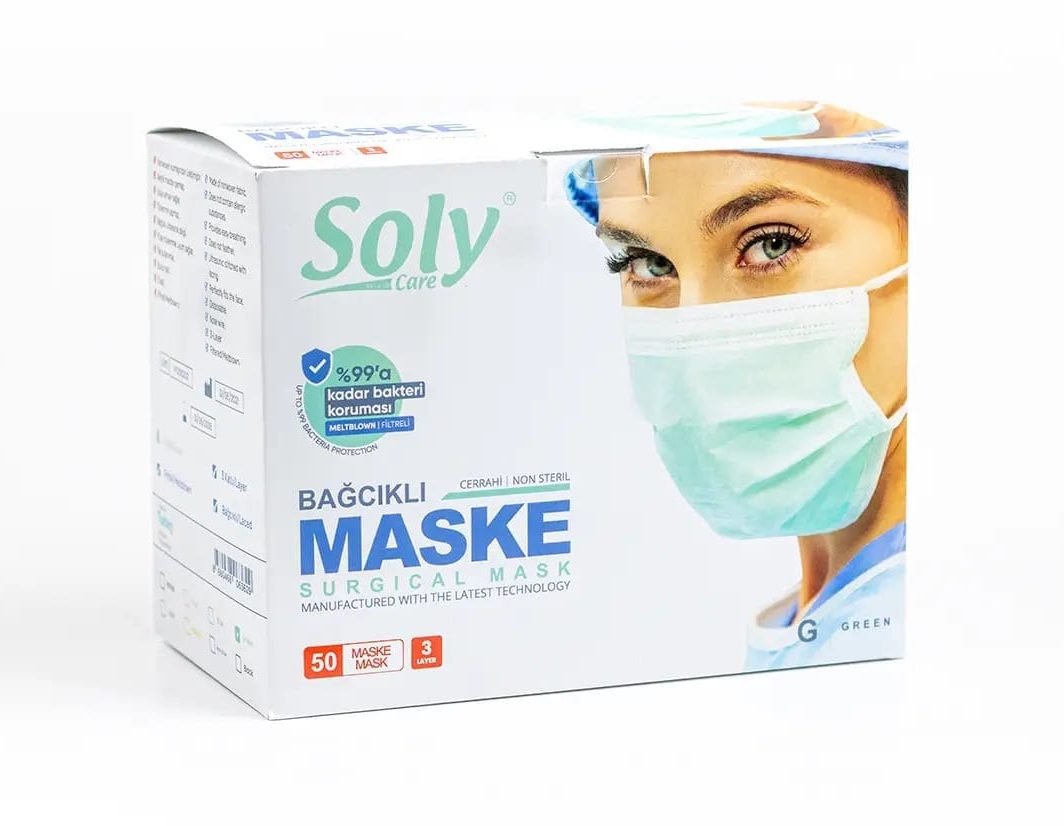
Sier Sağlık manufactures and exports Soly Care surgical masks in Type II and Type IIR configurations, fully compliant with EN 14683:2019+A1:2022. Our masks are produced with a three-layer structure including a meltblown filtration layer, and every production batch undergoes third-party BFE testing before shipment.
Our certification portfolio includes CE marking with Notified Body reference, EN 14683 Type II and Type IIR compliance documentation, ISO 13485 quality management system certification, Ekoteks meltblown material certification, and Turkish Ministry of Health registration.
All documentation is available for review prior to ordering. Visit our Documents page or contact our export team directly at info@siersaglik.com.
Browse our full range of CE-certified Surgical Masks and request a quotation for your next procurement cycle.
Frequently Asked Questions
Are EN 14683 surgical masks the same as FFP masks?
No. EN 14683 covers surgical masks, which are fluid-resistant barriers primarily protecting the environment from the wearer. FFP masks (EN 149) are respirators designed to protect the wearer from airborne particles. They serve different purposes and should not be substituted for one another in clinical settings.
Can EN 14683 masks be exported outside Europe?
Yes. EN 14683 is internationally recognized as a leading standard for surgical mask quality. Many procurement agencies in the Middle East, Africa, and Central Asia specifically request EN 14683 certified products as a quality benchmark, even when local regulations do not mandate it.
What is the shelf life of EN 14683 surgical masks?
Shelf life depends on the manufacturer’s validation, but most CE-certified surgical masks carry a five-year shelf life from the production date when stored in appropriate conditions — away from direct sunlight, humidity, and chemical exposure.
How do I verify a surgical mask’s EN 14683 certification is genuine?
Request the full Declaration of Conformity with the Notified Body number, then verify that Notified Body on the European Commission’s NANDO database. Also request the third-party laboratory test reports — a genuine CE certificate will always be backed by accredited test results.
Conclusion
EN 14683 is the benchmark standard for surgical mask quality in the European market and beyond. Understanding the difference between Type I, Type II, and Type IIR — and knowing what documentation to request — protects your procurement process and your patients.
Sier Sağlık supplies EN 14683 Type II and Type IIR surgical masks with full CE certification and third-party test documentation. If you are evaluating us as a supplier, our export team is ready to provide a complete documentation package and product samples upon request.

